
2 min read
DESIRE PATHS
Desire Paths: The Hidden Dynamics of Your Organisation In every organisation, there's an invisible map of how work truly gets done. While official...
We’ve officially crossed the Rubicon. For years, organisational value was tied to production—how fast your team could draft a proposal, write code, or create marketing copy. In medium and large enterprises across Australia, Singapore, and New Zealand, we’ve conditioned leaders to measure output.
But the advent of generative AI has completely flipped the script. Today, "creation" is no longer a premium skillset. It’s a commoditised utility. When anyone can generate a 2,000-word report in twenty seconds, the value of the raw content drops to zero.
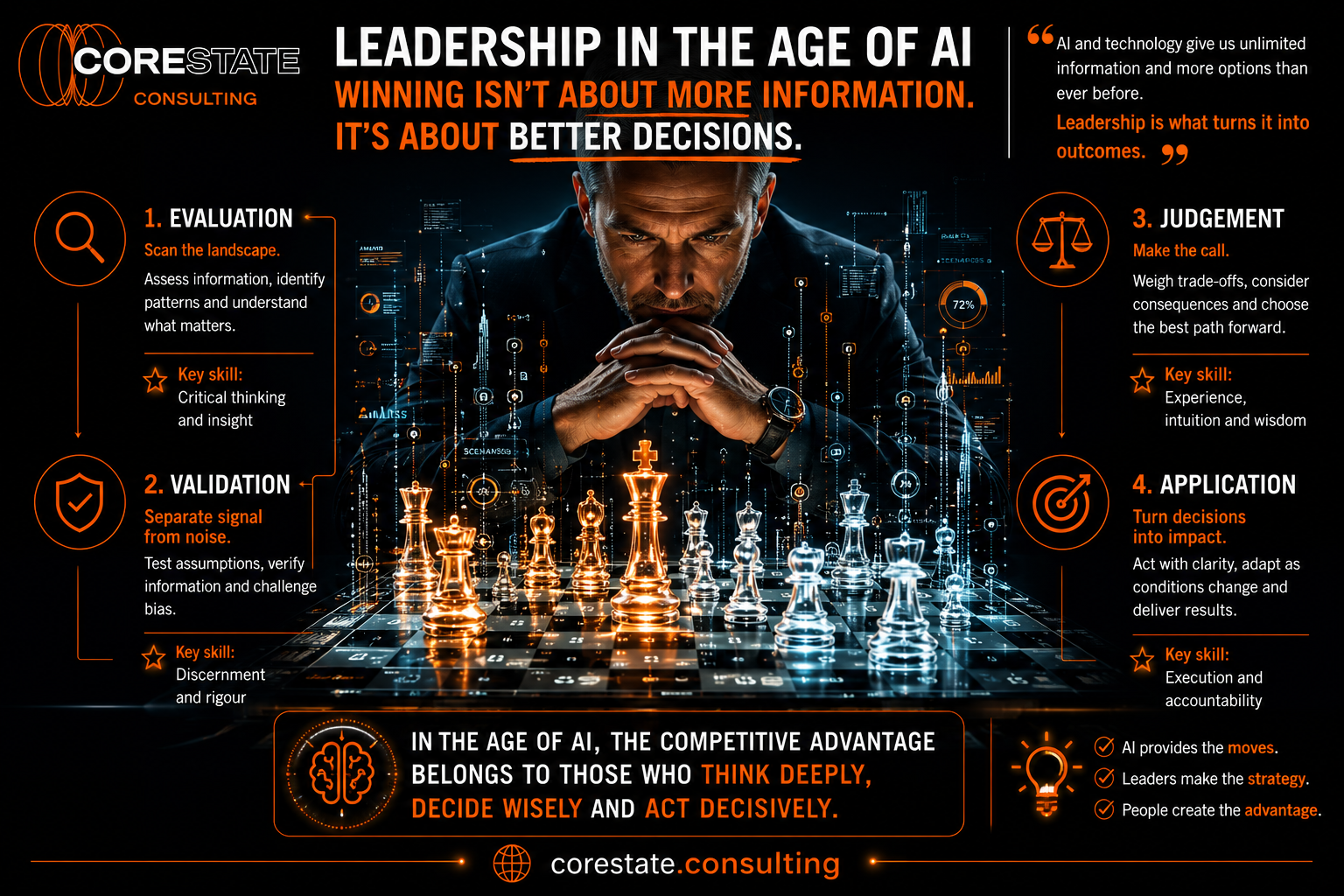
The real currency of the modern leader? Validation, evaluation, and raw human judgement.
As a leader, your role is shifting from a production editor to a high-stakes gatekeeper. AI can give you a thousand strategic options, but it cannot carry the accountability for choosing the wrong one. Popular author Mustafa Suleyman highlights this shift beautifully in his recent book, The Coming Wave, noting that navigating the sheer velocity of AI output requires containment, critical curation, and intense human oversight.
But there is a catch; sorting through endless AI-generated options causes intense cognitive fatigue. Neuroscientists know that the Orbitofrontal Cortex (OFC)—the brain region responsible for calculating value and making choices—is incredibly energy-hungry. When you’re constantly evaluating data, your brain burns through glucose rapidly, leading to "decision fatigue." This is when leaders start making poor choices or defaulting to the safest, least innovative path.
There is a strong argument that by outsourcing the "creation" phase entirely to AI, we risk losing deep domain expertise. The argument goes that you cannot develop elite judgment without first mastering the messy, tactical process of creating things from scratch. If future leaders rely solely on AI to generate ideas, will they possess the foundational knowledge required to validate them?
It’s a fair critique. But the reality of modern business means we can’t turn back the clock. We must adapt our management styles to focus on critical thinking over processing power.
When viewed through Bloom’s Taxonomy (a framework that describes thinking styles and applications, and one of our personal favourite reference models!), we see a profound shift. The bottom tiers of the taxonomy (Remembering, Understanding, and Applying/Creating raw information) are now heavily automated. The true value of a leader has moved entirely to the highest tiers (Higher Order Thinking Skills = HOTS): Evaluating and Analysing. Leadership today is about critiquing the AI's output, questioning its biases, and contextualising its data.
To protect your team's cognitive bandwidth and sharpen their analytical focus today, implement the "Tri-Option Filter".
Let’s stop rewarding people for making more noise and start promoting them for making the right call.
#FutureOfWork #ExecutiveDecisionMaking #NeuroscienceOfLeadership #GenerativeAI #ManagementOptimisation #CoreStateConsulting
2 min read
Desire Paths: The Hidden Dynamics of Your Organisation In every organisation, there's an invisible map of how work truly gets done. While official...
4 min read
The IWD likability trap When I spoke at the Women In Agile event for IWD this year, I was trying to be open to change and wanted to acknowledge...
2 min read
What tools can you use for Problem Solving? There are heaps! The best approach is to think of the solution or outcome you need and then pick the...